What Must Happen Now
A wrong flood model risks putting families and homes in danger
If a flawed flood model is used for the Guildford Timber Company development proposal, Pinehaven and Silverstream could face increased flood, erosion and landslide risk. An independent model rebuild is needed now.
The issue in one sentence
The model appears to overstate existing flooding while understating the extra runoff from future development that could increase flood and landslide hazards.
An independent rebuild is needed before this model is locked into Tiaki Wai MetroWater Ltd on 1 July 2026.
Start with the story, then read the evidence
What Must Happen Now
Why We Wrote This Book
A short, readable background story that explains the journey, the people, and why the evidence matters.
Main report
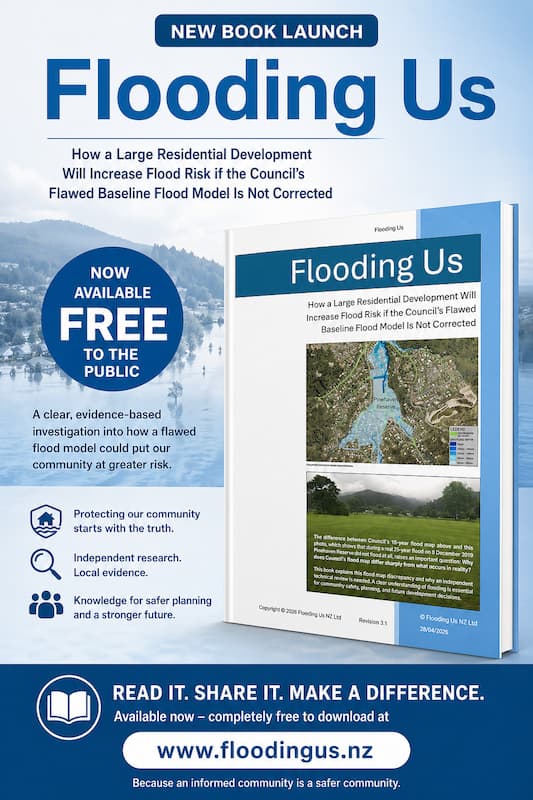
Flooding Us
The full evidence-based investigation into how a flawed baseline flood model could put the community at greater risk.
Three reasons this matters now
1
The flood maps don't match real floods
Three recent floods did not flood Pinehaven Reserve and about 100 homes shown flooded on Council’s 1-in-10-year maps.
2
The baseline appears inflated
The model appears to treat today’s forested hills as if GTC’s future development runoff already exists.
3
Decisions and spending are happening now
Streamworks escalated from $10.7 million to about $61 million, residents upstream of Pinehaven Reserve receive no flood-protection, GTC is progressing development, and key decisions are being made behind closed doors.
Plain-English logic
Three real storms, all larger than 1-in-10-year events, did not flood most of the areas and homes that are shown flooded in Council’s 1-in-10-year flood map. The flood maps are wrong.
Therefore: the current flood model needs independent rebuilding before it is relied on for development, stormwater neutrality, LIMs, overlays or public investment.
The evidence in brief
Council’s 1-in-10-year Pinehaven flood maps show Pinehaven Reserve and about 100 homes as flooded. But three larger real floods did not flood those areas:
- 8 Dec 2019 – about a 1-in-25-year flood
- 16 Feb 2026 – about a 1-in-15-year flood
- 18 Apr 2026 – a 1-in-15 to 1-in-20-year flood
Documents released under the Official Information Act show that, in a GTC “future case scenario”, the model used the same rainfall-loss assumptions for today’s forested hills and for a future urban development. In plain English, the model appears to treat the existing forest as if it already sheds stormwater like houses, roads and hard surfaces.
That matters because it hides the real increase in runoff from future development. If the baseline is wrong, stormwater neutrality may also be wrong.
If GTC’s development goes ahead based on this current flood model, the risk is that extra runoff and erosion will be underestimated – leading to bigger floods and greater landslide risk in Pinehaven and Silverstream.
An independent rebuild of the flood model is needed now, before this exaggerated model is locked into Tiaki Wai MetroWater Ltd on 1 July 2026.
Stay In Touch
We welcome genuine questions, constructive comment, and helpful information.
- Follow us on Facebook: @floodingus.nz
- Keep informed with updates at: www.floodingus.nz
- Email us: info@floodingus.nz
Community knowledge matters. Many of the most important facts in this story came from residents who cared enough to speak up.